Opuntia X occidentalis Engelm. & J. M. Bigelow (pro sp.)  
Family: Cactaceae


Images
not yet
available
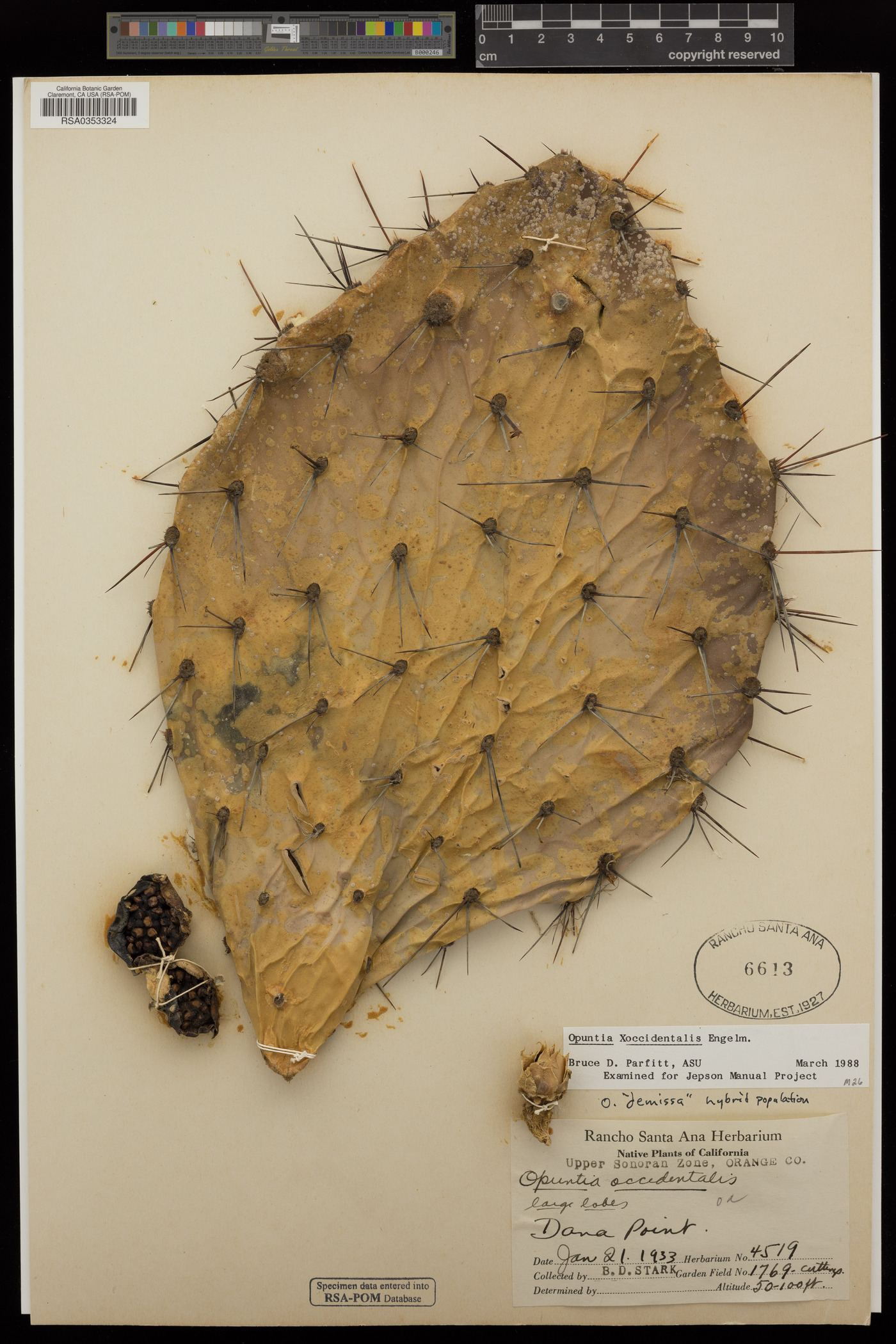
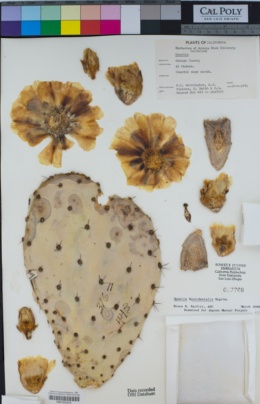
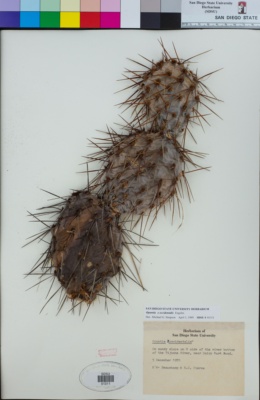
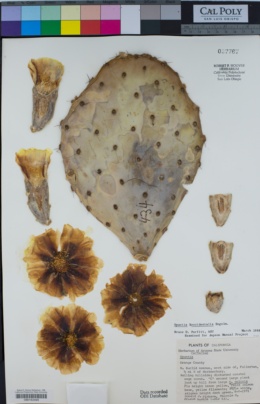
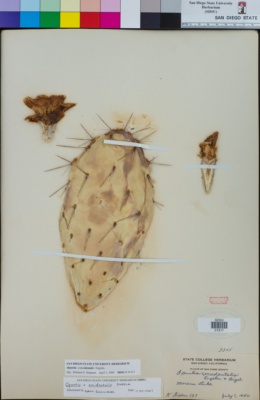
Shrubs, sprawling to erect, to 1.5 m. Stem segments not disartic-ulating, green, flattened, obovate, 19-35 × 14-18 cm, ± tuberculate, glabrous; areoles 5-7(-8) per diagonal row across midstem segment, oblong, 5-8 × 4-6 mm; wool dark brown. Spines 3-6 per areole, in most areoles (rarely few spined), spreading, straight, angularly flattened, subulate; abaxial 2-4 spines reflexed, shorter, to 20 mm; adaxial 1-2 spines yellow or white chalky with brown basal portions, 25-50 mm. Glochids in moderately dense crescent at adaxial edge of areole and subapical tuft, reddish brown, to 6 mm. Flowers: inner tepals yellow to deep pink, sometimes darker blush near base, to 50 mm; filaments usually yellow or white; anthers yellow; style pink or white; stigma lobes green. Fruits red-purple throughout, obovoid, 45-50 × 30-40 mm, juicy, glabrous, spineless; areoles 24-30. Seeds yellow-tan, 4-5.5 mm; girdle protruding to 1 mm. 2n = 66. Flowering spring (Apr-May). Coastal sage scrub, chaparral; 10-500 m; Calif. (including Channel Islands); Mexico (Baja California). Opuntia ×occidentalis is a hybrid complex involving three, perhaps more, species [at least O. littoralis × (O. engelmannii × O. phaeacantha)]. The hybrids are morphologically variable; the putative parents are all hexaploid. Another similar putative hybrid, O. demissa, probably involves O. oricola (B. D. Parfitt and M. A. Baker 1993).

       Web Links       View Parent Taxon       Close window