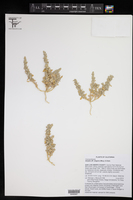
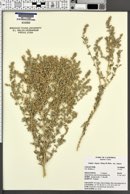
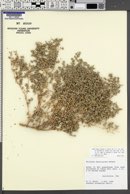
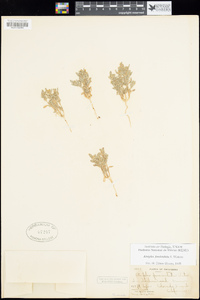
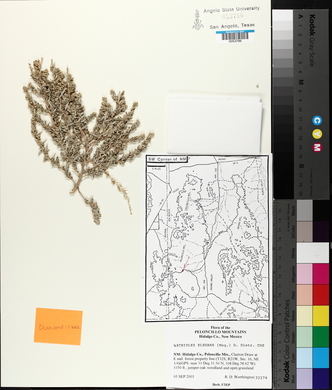
Atriplex elegans (Moq.) D. Dietr. 
Family: Chenopodiaceae
wheelscale saltbush,  more
[Atriplex elegans var. thornberi M.E. Jones,  more]
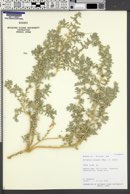
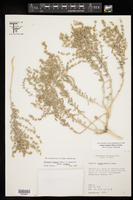
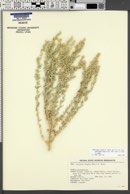
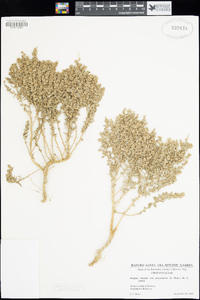
Atriplex elegans image
Arizona State University Herbarium  
 
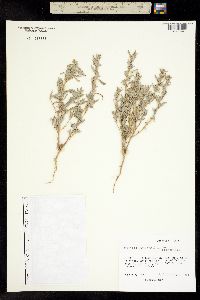
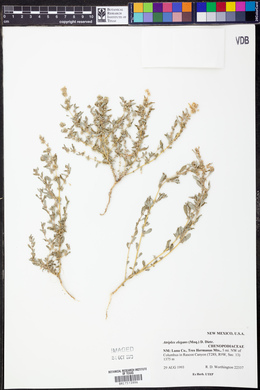
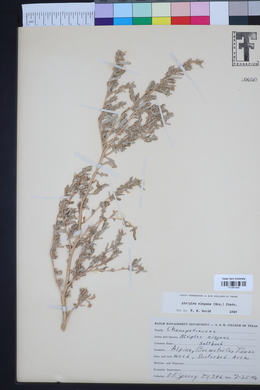
Plant: Annual ± 1-5 dm; stems decumbent to ascending, ± branched, finely scaly, becoming glabrous Leaves: alternate, entire; blade 5-25 mm, elliptic to oblanceolate, densely white-scaly below, entire to dentate, tapered to basealternate, entire; blade 5-25 mm, elliptic to oblanceolate, densely white-scaly below, entire to dentate, tapered to base Inflorescence: Staminate inflorescence: spike or spheric cluster; bracts 0; Pistillate inflorescence: clusters to spike- or panicle-like; bracts in fruit 2-3.5 mm, fused to near top, round, smooth or with 1 low tubercle, toothe Flowers: Staminate flower: calyx lobes 3-5; stamens 3-5; Pistillate flower: calyx ± 0; ovary ovoid to spheric, style branches 2 Fruit: an utricle; Seed 1, 1-1.5 mm, brown, erect Misc: Saline or alkaline soils, dry lakes; < 1000 m. Notes: Fruit; at maturity inclosed by bractlets, bractlets herbacious and evenly and deeply dentateLeaf; hairs are simple, inflated hairs, grayish or whitish.Inflorescence; in clusters or glomerules.Sepals; staminate flowers have 3-5, pistallate flowers have 2 appressed orbicular bracts. References: Kearney & Peebles; Arizona Flora. McDougall; Seed plants of N. Arizona. Hickman ed.; The Jepson Manual.
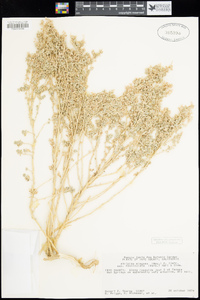
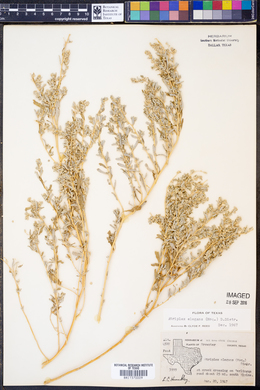
Atriplex elegans image
Max Licher  
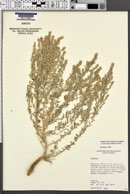
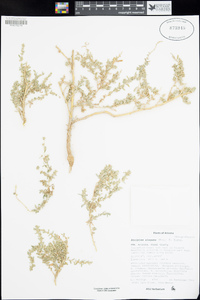
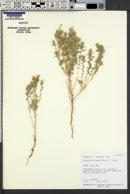
Atriplex elegans image
Arizona State University Herbarium  
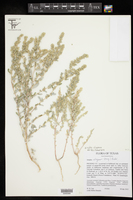
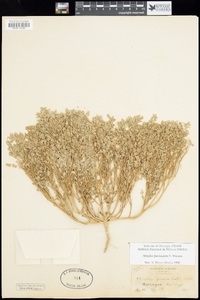
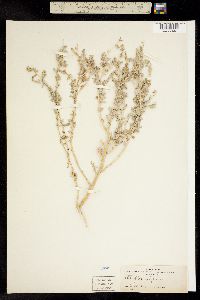
Atriplex elegans image
Arizona State University Herbarium  
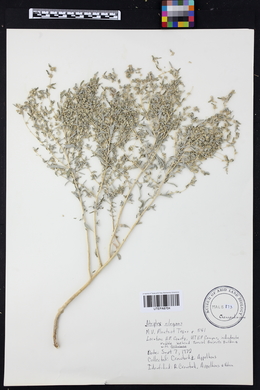
Atriplex elegans image
Arizona State University Herbarium  
Atriplex elegans dot map
More Photos       Web Links       View Parent Taxon       Close window